
Not Everything Moves Together: Three Years That Prove Why Diversification Works
Silver rose 145 percent in 2025 and is down 24 percent this year. Sudhir Pai walks through three years of asset class returns, and the Magnificent Seven, to show why the leader changes every year and why a diversified, rebalanced portfolio is the answer.
By Sudhir Pai, Managing Principal, MyTimeEquity
Silver was up 145 percent last year. This year, it is down 24 percent.
Read those two numbers again. The same asset, back to back years, moving in completely opposite directions. That, in two numbers, is the whole case for diversification.
Not all asset classes move in the same direction. They do not even move in the same direction within the same year. Every year has a different leader, and the investor who chases last year's leader usually learns this the hard way. Here is what the last three years actually looked like.
Three years, three different leaders
The table below shows total returns for the major asset classes, using well known ETFs as a guide. The 2026 numbers are year to date through October 28, 2026. The 3 year average is the simple average of the 2024, 2025, and 2026 year to date returns, and since 2026 is only a part year, please treat it as indicative. The 10 year average is the annualized total return over the last 10 years.
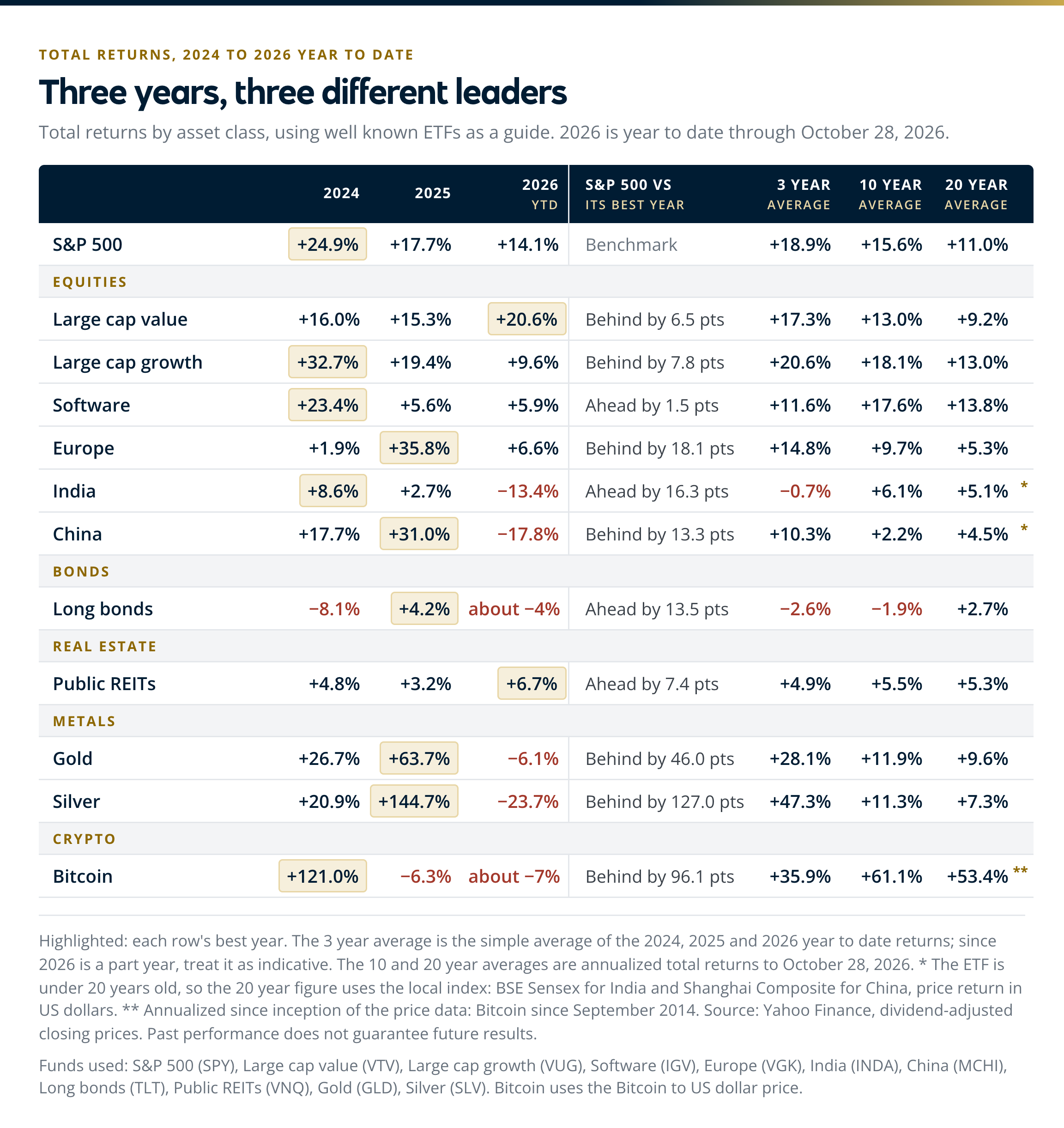
In 2024, Bitcoin led everything, up 121 percent, and growth stocks were up 33 percent. Europe was up only 2 percent, and long bonds actually fell 8 percent. If you owned only bonds and international stocks that year, you felt left behind.
In 2025, the whole picture flipped. Silver rose 145 percent and gold rose 64 percent. Europe rose 36 percent and China rose 31 percent, and developed and emerging markets both rose about 35 percent. Bitcoin, the hero of 2024, fell 6 percent, and India rose only 3 percent.
This year, the rotation has turned again. Value stocks, which nobody was excited about, lead the market, up 21 percent. Emerging markets are up about 17 percent and international markets about 14 percent, even though the China and India ETFs are down, because other markets within those groups are doing the heavy lifting. Meanwhile, silver is down 24 percent, gold and Bitcoin are down about 6 to 7 percent, and long bonds are down again.
Now look at the best year column. In each of these three years, the S&P 500 was never the best performer. It trailed the best asset class of 2024, Bitcoin, by 96.1 points. It trailed the best asset class of 2025, silver, by 127.0 points. This year it trails large cap value by 6.5 points. On average over the three years, the S&P 500 trailed the year's best asset class by 76.5 points a year. The index is a solid, dependable performer, but it is never the winner, and the winner is a different asset every year.
The 10 year column tells the longer story. Over a full decade, Bitcoin leads everything at about 61 percent a year. Growth stocks come next at about 18 percent a year, software at about 18 percent, and the S&P 500 at about 16 percent a year. At the other end, China has returned only about 2 percent a year over 10 years, and long bonds are actually negative, at about minus 2 percent a year. Notice silver as well. Its 3 year average looks spectacular at 47 percent, only because of the one huge 2025 spike, while its 10 year average is a much calmer 11 percent. Short windows can mislead. Long windows tell the truth.
Three years. Three completely different leaders. Nobody predicted this sequence, and nobody will predict the next one either.
Even the Magnificent Seven do not move together
This rotation does not happen only between asset classes. It happens inside the most famous group of stocks in the world.
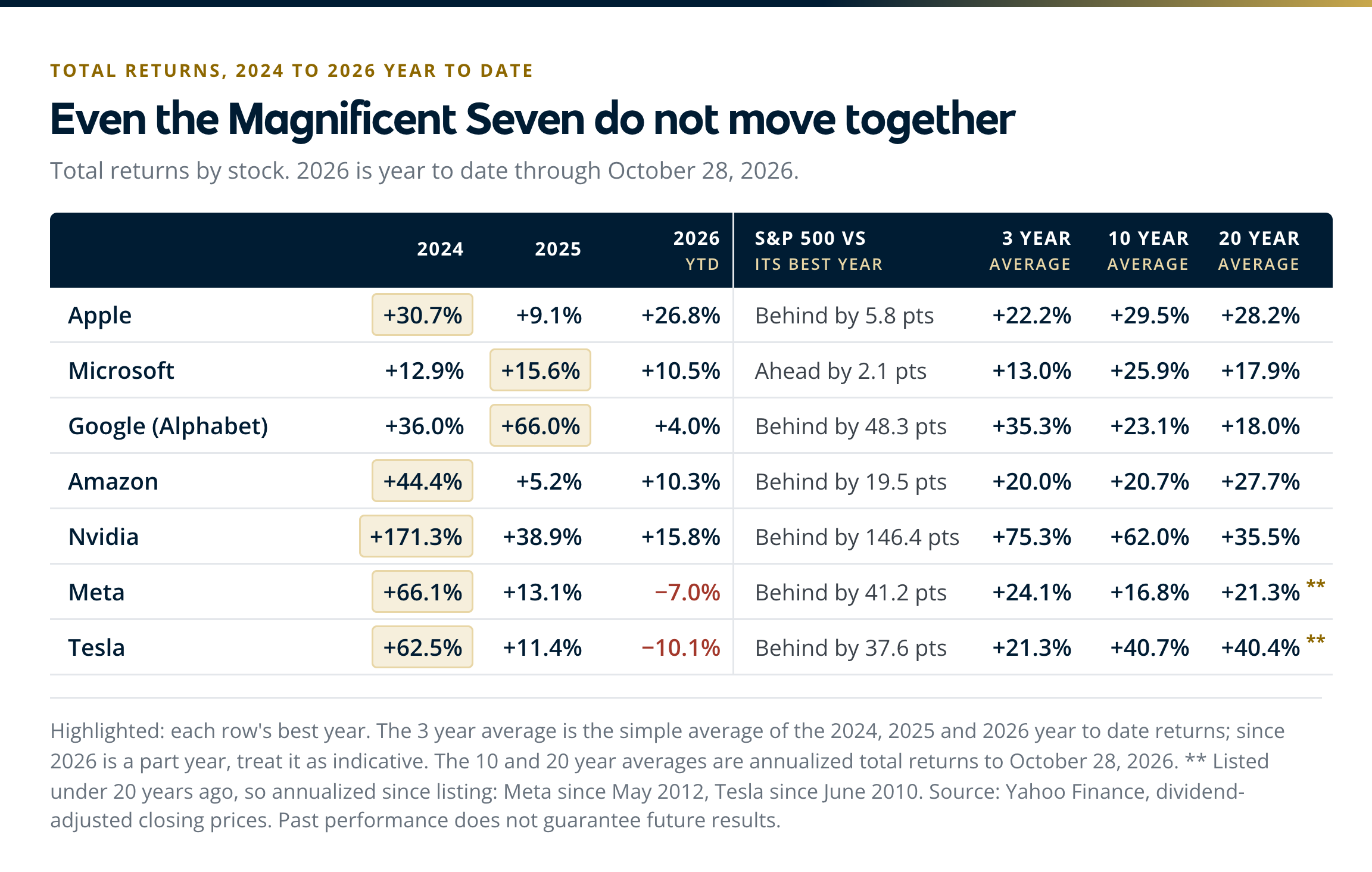
In 2024, Nvidia rose 171 percent while Microsoft rose only 13 percent. In 2025, Google was the leader, up 66 percent, while Amazon rose only 5 percent and Apple only 9 percent. This year, Apple leads, up 27 percent, while Tesla is down 10 percent and Meta is down 7 percent.
These are all great companies. They are in the same index, in the same sector, and often in the same portfolio. And yet their returns are completely different every single year. Even over 10 years the spread is wide, from Nvidia at about 62 percent a year down to Meta at about 17 percent a year.
Even inside technology, the split is clear. Software stocks, measured by the IGV ETF, were up about 23 percent in 2024, but only about 6 percent in 2025, and only about 6 percent this year. Software has lagged badly while the AI and semiconductor names ran. Same sector, very different story.
Fear, greed, and the comparison trap
Here is where most investors get hurt. When one asset runs up, fear and greed push us to chase only that one. When another asset is down, we compare it with the S&P 500 and feel that our portfolio is not doing well.
That comparison is the mistake. In a properly diversified portfolio, something is always winning and something is always lagging. That is not a failure of the portfolio. That is the portfolio doing its job. The year the lagging asset becomes the leader, you will be glad you owned it, and you will only own it if you were patient when it was down.
The Google lesson
Google gave a live example on October 29. The stock fell about 10 percent that morning after the company reported earnings. With that one day fall, Google gave up its small gain for the year and went negative year to date.
If you liked Google for the last one and a half years, when it rose 36 percent in 2024 and 66 percent in 2025, do not start hating Google on one bad day. One earnings report does not change what the company is. Be patient with it.
There is a second, equally important lesson in the same example. If Google ran up so much that it became too big a part of your portfolio, that is what rebalancing is for. Trim some of that growth, book some of that gain, and reallocate it to other asset classes. That is how a winner funds the rest of your portfolio, instead of becoming a risk inside it.
Real estate has two sides
Public REITs have been the quiet, steady performers in the table above, up about 5 percent in 2024, about 3 percent in 2025, and about 7 percent this year. No drama, no headlines, just steady progress.
Private real estate is a different story, and it deserves an honest word. In Reg D private placements, particularly in multifamily and office, there are real challenges today. Many sponsors took on a lot of leverage when money was cheap, and interest rates since then have not moved in favor of the sponsors. When those loans come up for refinancing, it can cause some stress in the deal.
But the lesson of this entire post applies there too. Real estate moves in long cycles. The answer in a stressed phase is patience, to wait for the turnaround to happen, rather than panic at the bottom of the cycle.
Watch where the money flows
Money rotates. When money flows into real estate, metals, and crypto, AI stocks often take a hit, and you may see a correction in growth stocks. When money flows back into growth, the defensive assets cool off. This is rotation, money moving from one asset class to another, and it is completely normal. It does not mean any one story is over. It means you should own more than one story.
Data note: Returns shown are total returns, using ETFs as proxies for each asset class, through the close on October 28, 2026. The Google move is as of the morning of October 29, 2026. This post is for information and education only. It is not investment advice or a recommendation to buy, hold, or sell any security. Past performance does not guarantee future results. Every investment decision should be your own, based on your situation and your advisor's guidance.
MyTimeEquity. MyTimeEquity, LLC is registered as an investment adviser with the U.S. Securities and Exchange Commission (SEC File No. 801-136955). Registration does not imply a certain level of skill or training. MyTimeEquity, LLC (“MTE”) is a registered investment adviser based in Plano, Texas, serving investors who want ongoing advice on a managed portfolio rather than participation in individual private-market transactions. MTE is a separate firm from MTE Private Equity LLC (MTEPE), an affiliate under common ownership. MTE also acts as investment adviser to certain private funds with which MTEPE is involved, and those funds pay management fees to MTE’s affiliates; this conflict of interest is described in MTE’s Form ADV Part 2A and Form CRS. Advisory services are offered only by MTE, only under a written advisory agreement, and never by MTEPE. Information MTE shares is for educational and informational purposes only and is not investment, legal, tax, or accounting advice, or a recommendation to buy or sell any security. All investments involve risk, including the possible loss of principal, and past performance is not indicative of future results.
MyTimeEquityPE. MTE Private Equity LLC (MTEPE) is a Texas limited liability company engaged in private-market investments across real assets, digital assets, and late-stage private equity. MTEPE is not (i) an accounting or CPA firm, (ii) a broker-dealer, or (iii) a registered investment adviser (RIA). MTEPE does not offer securities to the public: any offer or solicitation is made only to verified accredited investors, and only through the definitive offering documents for a specific transaction, including the applicable Confidential Private Placement Memorandum. Private-market investments are speculative and illiquid, involve the risk of total loss of capital, and are not suitable for every investor. Prospective investors should read the offering documents in full and consult their own legal, tax, and financial advisers before investing.
Educational material about how these structures work. It is not an offer to sell or a solicitation of an offer to buy any security, and it does not describe any specific investment. Any offer is made only through definitive offering documents.